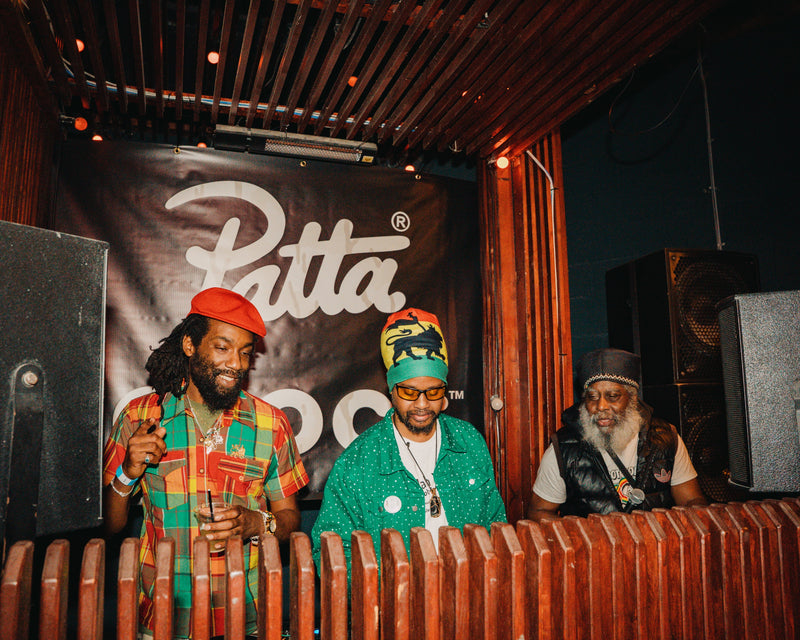
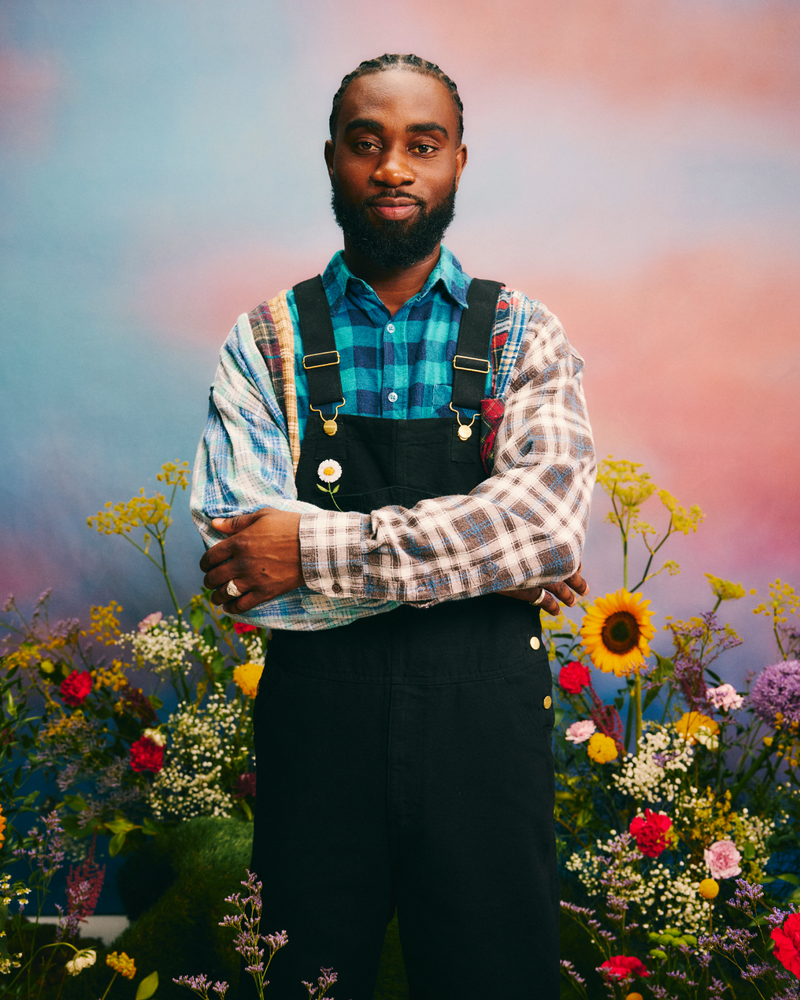
Interview by Marco Sottana and Passion DzengaFor Angelo Marcus Elizabeth, fragrance has always been about more than smelling good. It is a way of holding onto memory, identity and the places that shape you. Born and raised in Curaçao and now based in Amsterdam, Angelo brings those worlds together through Marcus Elizabeth, a constantly evolving creative universe rooted in an Afro-Atlantic perspective.That world now crosses paths with Patta for Saffron Attitude, a warm and confident fragrance built around saffron, leather, incense and woods, with bergamot, ginger and cardamom cutting through the mix. After first introducing the collaboration in Paris, we bring things back home to Amsterdam.We caught up with Angelo to talk about his unexpected route into perfumery, turning confidence into something you can smell, and why the best fragrances need a little dirt under their fingernails.Before we get into perfume, who is Angelo Marcus Elizabeth, and what was the creative journey that brought you to where you are today?I’m a designer and perfumer from Curaçao, now based in Amsterdam. I’ve always been interested in the way objects, clothes, images and scents can carry identity and memory. As a child, I was constantly drawing and paying attention to patterns, colours, shapes and materials. Fashion eventually became the first professional language through which I could turn those observations into something tangible.Fragrance came into my life much more unexpectedly. During the pandemic, I started making scented candles at home, initially because I wanted to work with my hands and quiet my mind. At first, I was making them for myself, then for friends and family, but gradually I became much more interested in the scent itself. I became fascinated by how a handful of materials could create an entire atmosphere, bring back someone you hadn’t thought about for years, or completely change the feeling of a room.That curiosity eventually became Marcus Elizabeth. Today, I don’t really see fashion, perfume and objects as separate disciplines anymore. To me, they are simply different ways of telling and expressing the same story.You originally came from fashion and design. What could working with scent give you creatively that clothing couldn’t?Scent gets past the eye. With clothing, there is almost always an immediate visual judgement: you notice the silhouette, the colour, the styling, perhaps gender or status. Fragrance is much harder to control in that way. Someone can smell something and connect emotionally with it before they have even decided whether they consciously “like” it. I found that incredibly powerful.Fashion taught me about proportion, material, contrast and construction, and I still use all of those ideas when I think about perfume. Fragrance gives another level of intimacy. You can wear a perfume underneath everything and nobody necessarily has to know it is there. It can feel completely private, while at the same time changing the way other people experience your presence. That combination of intimacy and impact is something I find very special.You were born and raised in Curaçao before making Amsterdam home. What do those two places smell like to you?Curaçao smells warm to me. I think of sun on skin, humidity, salt, dry earth, plants just after they have been watered, fruit ripening, flowers, cooking and the sea. There is a certain density to smell in a hot climate; everything seems to project differently.One of my strongest memories is my grandmother’s garden. There were mangoes, mispel, papaya, guava, watermelon and citrus. I had to water the plants every day, and that is where I really started noticing that every plant had its own smell. I loved the lemon tree in particular. Sometimes I would put pieces of lemon peel in my pocket just so I could keep smelling them throughout the day.Amsterdam is completely different. I associate it with cooler air, rain, wet stone, wood, old buildings, coffee and, during winter, sometimes smoke drifting out of chimneys. At the same time, Amsterdam is such an international city that you can turn a corner and suddenly smell spices or food that transport you somewhere completely different.Curaçao gave me warmth and instinct, while Amsterdam gave me structure and contrast. I think Marcus Elizabeth exists somewhere between those two worlds.Are there particular materials, smells or olfactive memories from either place that continue to find their way into your work?Definitely. Citrus peel, green leaves, tropical fruits, flowers, dry woods, warm skin and the smell of the sea keep returning in different ways. But I’m usually more interested in translating the memory than reproducing the smell literally.If I think about fruit from Curaçao, for example, I don’t necessarily want to make a perfume that smells like fruit juice. I might be more interested in the skin of the fruit, its bitterness, a green stem, the humidity around it or simply the sensation of eating it in the heat. Those details often feel more personal and more interesting to me.Amsterdam brings another set of textures into the work: woods, leather, wet stone or mineral notes, smoke and clean musks. Those materials allow me to put structure around the warmth. Again, it is that contrast between the two places that often becomes the starting point.Marcus Elizabeth describes itself as being carried by an “Afro-Atlantic essence.” What does that mean to you personally, and how does something as broad and layered as that actually translate into an olfactive identity?For me, Afro-Atlantic is not a perfume note and it isn’t a formula. It is a way of understanding where I come from. Curaçao sits at an intersection of Africa, the Caribbean, the Americas and Europe. Our language, food, music, architecture and rituals have all been shaped by movement across the Atlantic. There is a lot of beauty in that, but also a very complicated history.I don’t want to reduce something so layered to “tropical notes” or to a stereotypical idea of what a Caribbean fragrance is supposed to smell like. Instead, it influences how I put materials together. I’m interested in warmth alongside discipline, sensuality alongside restraint, something natural against something polished or urban.That can mean a tropical fruit meeting leather, or a floral placed next to something mineral or woody. Something familiar can be made slightly strange. That tension feels much closer to my identity than simply making something and saying: this smells Caribbean.Your journey into fragrance started with you making candles in your attic for yourself, friends and family. Do you remember the first scent you made where you thought, “there might actually be something here”?I remember the feeling more clearly than one exact formula. I was making scented candles very intuitively, without really thinking of them as a business, and then people started responding to them much more strongly than I had expected. They weren’t just saying, “this smells nice.” They wanted to know what the scent was, whether I could make another one or whether they could buy one for somebody else.That was when something shifted for me. I realised that I wasn’t simply making a scented object; I was creating an atmosphere that people wanted to bring into their own lives. From that moment on, I started taking the materials, formulation and the actual craft of perfumery much more seriously.How important is memory to the way you create a fragrance? Are there smells from your childhood that you can still access instantly?Memory is probably one of the most important things in my work. Smell is strange because a memory can disappear from your conscious mind for years, and then one scent suddenly brings the entire thing back. It is not only the image. You remember the temperature, the place, the person and sometimes even exactly how you felt in that moment.My grandmother’s garden is still very accessible to me in that way, especially the citrus leaves and peels, but also bananas, mangoes, flowers and the smell of plants after they have just been watered.I don’t necessarily try to reconstruct those memories literally in a perfume. I use them more as raw material. Sometimes only one small part of a memory enters the fragrance: a green note, a bitter peel effect, a humid floral feeling or a warm wood.For me, perfume can be a door to memory, but the beautiful thing is that it can also create completely new memories for the person wearing it.How do you reference where you come from without becoming nostalgic or overly literal?That is something I think about a lot, because heritage should never become costume. If you translate everything literally, you can very quickly reduce a culture to a set of recognisable symbols: coconut, rum, tropical flowers, bright colours. That doesn’t represent my experience of Curaçao.I would rather take something culturally specific and ask myself what it actually means to me emotionally or materially. What is the texture of that memory? Where is the tension in it? What happened around that smell?From there, I can translate it into something contemporary. The goal is never to recreate the past perfectly. I want the past to have a conversation with the person I am today.When you begin developing a new fragrance, what comes first?A new fragrance can begin almost anywhere. Sometimes the starting point is a material, sometimes a name arrives first, and sometimes it is an image, a person, a place or even a contradiction that I find interesting.The first question I normally ask myself is: what should this perfume feel like? From there, I begin collecting references and materials and start building an accord that captures the central idea. Once that accord works, the process becomes almost architectural. I start asking what needs to support it, where the tension should come from, what needs to disappear and how the fragrance should move from the opening into the skin.I rarely want a perfume to explain itself completely within the first five seconds. I like the idea that you have to discover it gradually.Let’s get into Saffron Attitude. What was the first conversation between Marcus Elizabeth and Patta, and at what point did you realise there was a fragrance to be made together?The first conversation actually wasn’t about making a perfume. It was much more fundamental: we were talking about whether Marcus Elizabeth and Patta were genuinely a good match, and whether bringing these two worlds together could become the beginning of something beautiful rather than simply a one-off collaboration.A big part of that conversation was also about my ambitions as a black perfumer and founder. The perfume industry still has very few black perfumers and black-owned houses with real visibility, particularly at the level where I want Marcus Elizabeth to operate. I spoke very openly about where I want to take the brand, the space I want to create within the fragrance industry and what it means to build that from my own perspective.The question then became: what role could Patta play in that journey? Patta truly asked how can we help? That made the collaboration much bigger to me than simply putting two brand names next to each other. Patta has spent years building a platform around culture and community and creating space for people and ideas that do not necessarily come through traditional routes.Once we realised there was a genuine alignment between us, fragrance became the natural medium through which to express it. Saffron Attitude grew from that conversation and became a fragrance about presence, confidence and taking up space without apologising for it. In that sense, the idea behind the scent is very closely connected to the reason the collaboration exists in the first place.If you had to describe Patta into an olfactive identity before this collaboration existed, what would it smell like?Warm, direct, textured and slightly rebellious. I would imagine spice, worn leather, woods and incense, perhaps with something mineral or metallic underneath. But there would also have to be freshness, because Patta has a lot of energy. I wouldn’t want it to become too heavy or nostalgic.It should smell like someone entering a room without asking permission to be there. And actually, when you describe it that way, you end up quite close to Saffron Attitude.Which side of saffron were you interested in bringing forward for Patta?The leathery, dry and spicy side. We didn’t want saffron to become overly sweet or conventionally luxurious. Saffron can have this almost metallic tension to it, and I find that incredibly contemporary.In Saffron Attitude, leather, incense and woods give the fragrance depth, while bergamot, ginger and cardamom keep energy running through the composition. So the saffron has presence, but it isn’t sitting there like a precious jewel that you aren’t allowed to touch. It has a little dirt under its fingernails.How do you translate something abstract like confidence into the texture, projection and composition of a fragrance?Confidence isn’t necessarily loud. Someone can walk into a room, barely say anything and still completely change the energy. That distinction was important when we were developing Saffron Attitude. I didn’t want to create a fragrance that simply screamed through enormous projection; I wanted it to have presence.You build that presence through contrast and structure. The opening immediately brings energy, while saffron, incense, iris and leather give the fragrance texture and identity. Then the woods underneath create stability and keep everything grounded.The end result has to feel composed rather than desperate for attention. For me, that is confidence: you notice it, but it doesn’t need your approval.How important was the progression, or drydown, to the fragrance?Very important, because I don’t think a perfume should be a photograph. It should be a film. The first spray of Saffron Attitude is bright, spicy and energetic, but then it gradually begins to reveal more texture. The iris changes the surface of the fragrance, incense introduces smoke, and the saffron and leather create warmth and tension.As it develops further, the woods, vetiver and amber become increasingly important. That evolution is part of the personality of the fragrance. You encounter the confidence first, but as you spend more time with it, you begin to understand the depth underneath.Was the contrast between bright and dark, fresh and warm, spicy and woody deliberately built into the fragrance?Absolutely. I’m very interested in contrast because people aren’t one thing either. Patta can be street and sophisticated at the same time, rebellious but also incredibly precise. Marcus Elizabeth similarly exists somewhere between island warmth and urban structure.It therefore felt very natural for the fragrance to contain those contradictions. Without the brighter elements, the leather, saffron and woods could easily become too heavy. At the same time, without those darker materials, the freshness would not have enough gravity.It is really the tension between those two sides that makes the fragrance interesting.Was there a version of Saffron Attitude that almost became the final fragrance but ultimately got rejected?We actually started with three completely different fragrance directions. Two of them were rejected, while Saffron Attitude was the one that immediately stood out to us.What made it feel right was its spicy, bold and warm character. It simply had more presence. There was something about the combination of saffron, spice, leather and woods that connected very naturally with the energy we associated with Patta, while still feeling refined and wearable.The other two fragrances had interesting qualities, but Saffron Attitude had the strongest identity. It didn’t just smell good; it had an attitude. Once we recognised that, the decision became quite clear.What does Patta bring to the fragrance that Marcus Elizabeth might not have arrived at on its own, and what did Marcus Elizabeth bring into Patta’s world?Patta brought a certain directness into the process. Marcus Elizabeth can sometimes be very introspective; we think a lot about memory, ritual, material and atmosphere. Patta brought community, street energy and a kind of unapologetic cultural confidence that pushed the collaboration in another direction.At the same time, I think Marcus Elizabeth brought another sensory dimension into Patta’s universe. Clothing is something you see and touch, and music is something you hear, while perfume is almost invisible yet incredibly intimate and personal.In that sense, both brands pushed each other slightly outside their usual medium, which is when I think collaborations become genuinely interesting. I’m very thankful that Patta gave us the opportunity and trust to create something together in this way.How did you translate the same olfactive idea into the Saffron Attitude candle?You can’t simply pour a perfume formula into wax and expect exactly the same experience. Skin has warmth, movement and its own chemistry, whereas a candle interacts with a flame, a room and the air around it.For the candle, I wanted the saffron, leather, woods and amber to create more of an atmosphere around you. It can be slightly warmer and more enveloping because it is scenting an entire space rather than sitting on one person’s skin.The perfume becomes part of your personal presence, while the candle changes the environment around you. They speak the same language, but they speak it in different voices.Paris was effectively the introduction, but this is a collaboration between two Amsterdam-rooted worlds. Does bringing Saffron Attitude back to Amsterdam for the official launch feel different?Definitely. Paris was very exciting because you have that Fashion Week energy around you, and it was essentially our first opportunity to introduce Saffron Attitude to a wider audience.Amsterdam feels much more personal. This is where Marcus Elizabeth has its atelier, where Patta has built such an important cultural presence and where our communities actually overlap. Bringing the fragrance back here therefore feels a little like completing the circle. Paris was the introduction; Amsterdam is where Saffron Attitude comes home.Has anyone’s interpretation of Saffron Attitude made you smell the fragrance differently yourself?What I really enjoy is seeing how differently people move through exactly the same fragrance. One person immediately finds the saffron and leather, while someone else connects much more strongly with the incense. Others first notice the brighter spices or the softness of the iris.As a creator, you know every decision that went into the composition, so at some point you stop experiencing it completely innocently. Then somebody describes something you made using completely different words and suddenly you smell that part of the fragrance again.I actually like losing some of that control. Once a fragrance belongs to somebody else, their own experiences and memories become part of it too.Who did you imagine wearing Saffron Attitude while you were making it?I deliberately didn’t imagine one specific person. I was much more interested in imagining an attitude: someone who has their own point of view and a certain confidence in who they are.That person could be twenty or sixty. They could be incredibly expressive or extremely quiet. What connects them is that they are not dressing, speaking or living primarily for somebody else’s approval.That feels much more interesting to me than designing a perfume around a conventional demographic.Do you think the traditional idea of “men’s” and “women’s” perfume still has any relevance?As a marketing category, it obviously still exists, but creatively it isn’t very useful to me. Smell itself doesn’t have a gender.Leather can be beautiful on anyone, rose can be powerful, woods can be sensual, vanilla can be dark and florals can feel masculine. Those classifications tell us much more about cultural conventions than they do about the materials themselves.I would much rather ask someone: does this smell like you? To me, that is a much more contemporary and personal way of thinking about fragrance.Do you see Marcus Elizabeth ultimately as a perfume house, or as a much wider creative universe where scent happens to be the starting point?Perfume is at the centre, but Marcus Elizabeth is gradually becoming a wider creative universe. I still very much think of it as a perfume house because scent is our most important language and the place where many of our ideas begin, but I’ve never wanted creativity to stop at the bottle.Artifacts, candles, fashion, objects, imagery and exhibitions can all belong to the same world, as long as there is a clear reason for them to exist. Ultimately, I’m interested in building a universe that you can smell, wear, touch and live with.What do you think people misunderstand most about the craft of perfumery?Probably how much editing is involved. From the outside, perfumery can sound incredibly romantic: you choose a few beautiful ingredients, mix them together and suddenly you have a perfume.The reality is much more precise. A tiny adjustment can completely change the balance of a composition. Sometimes you add more of something because you want it to become more noticeable and somehow it becomes less visible. You remove one ingredient and another suddenly becomes incredibly loud. Something can smell beautiful on a blotter and behave completely differently on skin.A lot of perfumery is repetition, evaluation and restraint. Knowing what not to add is often just as important as knowing what to add.What scent do you personally never get tired of?Fresh citrus peel. I think that probably goes all the way back to the lemon tree in my grandmother’s garden.When you cut or peel a citrus fruit and the oils are released into the air, there is something incredibly alive about that smell. It is so familiar to me, but somehow it still manages to surprise me every time.And finally, when somebody sprays Saffron Attitude and walks out of the door, what do you want them to feel?I want Saffron Attitude to feel like the final thing you put on before leaving the house. You’ve chosen your clothes, your shoes and maybe your jewellery, and then the fragrance is that final gesture that completes everything.Not because the perfume suddenly transforms you into somebody else, but because it brings something forward that was already there. It gives you that final sense of presence, confidence and attitude.You spray it, and you’re ready to go.Saffron Attitude is that final move before you step out the door. It is not about becoming someone else, but bringing a little more of yourself forward. Now, the fragrance comes home to Amsterdam, the city where both Marcus Elizabeth and Patta have built their communities.Come experience Saffron Attitude for yourself this Friday, September 11 at Patta Amsterdam, where the fragrance and accompanying candle will be available in-store.